
A small amount is also produced by ependymal cellsThe CSF cushions the brain and serves also as a sink that receives products generated by brain catabolism and synaptic function. The total CSF volume is 3-5 ounces 90-150 mL in adults and 03-2 ounces 10-60 mL in newborns.

Cerebrospinal Fluid Formation Absorption And Circulation Around And Download Scientific Diagram

Normal Csf Circulation The Ispn Guide To Pediatric Neurosurgery

Cerebrospinal Fluid Wikipedia
CSF cushions the brain and spinal cord against forceful blows distributes important substances and carries away waste products.

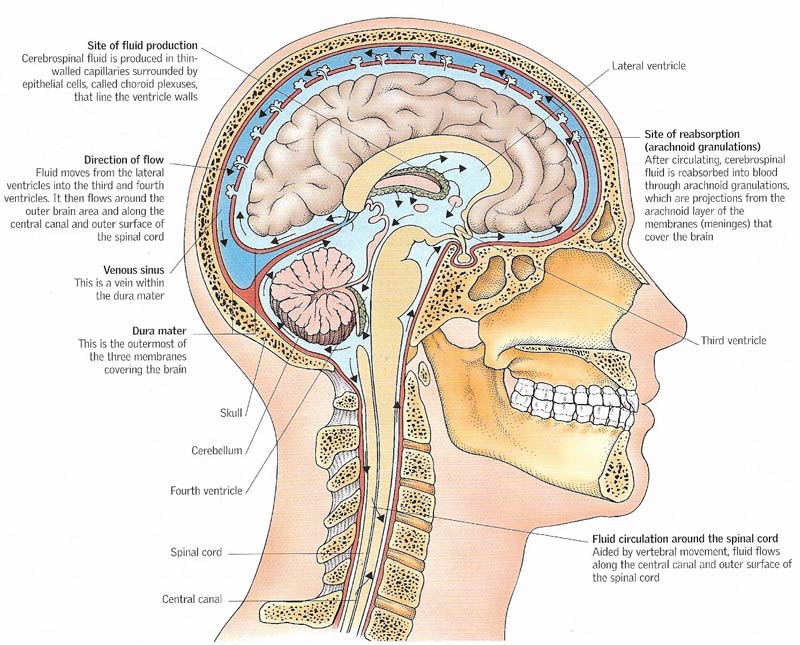
Where is csf produced and absorbed. The ventricles allow the CSF to flow around the spinal cord and brain while constantly being absorbed and replenished. Future work is needed to understand the intricacies of each. CSF is produced by specialised ependymal cells in the choroid plexus of the ventricles of the brain and absorbed in the arachnoid granulationsThere is about 125 mL of CSF at any one time and about 500 mL is generated every day.
It then circulates through the ventricles via foramina located between them. A cerebrospinal fluid leak can be either cranial or spinal and these are two different disorders. Cerebrospinal fluid CSF is a clear colorless body fluid found within the tissue that surrounds the brain and spinal cord of all vertebrates.
It occurs if the normal flow of CSF throughout the brain and spinal cord is blocked in some way. Financial support and sponsorship. CSF is produced inside the ventricles deep within the brain.
The CSF is added to this fluid and is absorbed and subsequently excreted through normal urination. Normally after circulating CSF is reabsorbed into the body through blood vessels. CSF is produced at a rate of approximately 20 mLh and an estimated 400-500 mL of CSF is produced and absorbed daily.
CSF fluid circulates inside the brain and spinal cord. But if too much fluid is produced or not enough is re-absorbed the CSF can build up and cause pressure within the skull which is an enclosed space. This pressure can cause symptoms similar to those of a brain tumor including worsening headache and vision.
The CSF is diverted into the peritoneal cavity. CSF is continually produced circulated and then absorbed into the blood. It is within hollow channels in the brain called ventricles that the fluid is produced.
Under normal conditions a delicate balance exists between the amount of CSF produced and the rate at which it is absorbed. This review surveys key developments leading to the traditional concept. This is a unique type of shunt which diverts CSF from an area within the spine not the brain not starting in the brain called the intrathecal space.
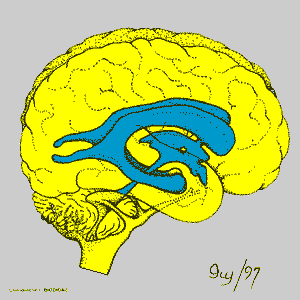
The CSF is produced and circulates through a series of communicating cavities or channels called ventricles. About 17 ounces 500 mL of CSF are produced each day. Cerebrospinal fluid is constantly produced at a secretion rate of 02-07 mlmin meaning that there is 600700 ml of newly produced CSF per day.
If the process of producing and removing CSF is disturbed CSF can accumulate causing hydrocephalus. CSF flows within and around the brain and spinal cord to help cushion it from injury. A cerebrospinal fluid leak CSF leak or CSFL is a medical condition where the cerebrospinal fluid CSF surrounding the brain or spinal cord leaks out of one or more holes or tears in the dura mater.
This sequence is called FLAIR. The pathway of the cerebrospinal fluid is as follows. Similarly in the brain we often want to detect parenchymal edema without the glaring high signal from CSF.
Since the total volume of CSF averages around 150-270 mL this means that the entire volume of CSF is replaced around 4 times per day. To do this we suppress CSF. From the fourth ventricle CSF accesses a system of subarachnoid cisterns flowing through the subarachnoid space of the brain and spinal cord until its finally absorbed into the venous system of the CNS.
This rate of production means. The cerebrospinal fluid CSF is produced from arterial blood by the choroid plexuses of the lateral and fourth ventricles by a combined process of diffusion pinocytosis and active transfer. Free radicals are produced by the reaction of unsaturated fatty acids with molecular oxygen and traces of other oxidants as metal ions Fe 3 and Cu 2.
Similarly it has been estimated that up to 20 of the CSF uptake occurs in the brain parenchyma or via the lymphatics near the cribriform plate or covering the cranial nerves in the basal cisterns. This causes the ventricles to enlarge putting pressure on the brain. It circulates out of the ventricles and into the subarachnoid spaces surrounding the brain and spinal cord.
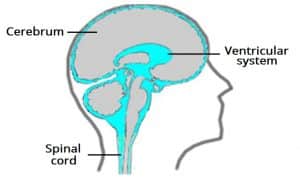
Cerebrospinal fluid blue is produced by the choroid plexus inside the ventricles and is constantfigcaption-centerbsorbed and replenished. A specialized structure within each ventricle called the choroid plexus is responsible for the majority of CSF production. The most common technique used is time-resolved 2D phase-contrast MRI with velocity encoding.
Ramis-Ramos in Encyclopedia of Food Sciences and Nutrition Second Edition 2003 Lipid Oxidation. CSF is absorbed by the arachnoid villi along the top of the brain. CSF flow studies are performed using a variety of MRI techniques and are able to qualitatively assess and quantify pulsatile CSF flow.
Importantly at first glance FLAIR images appear similar to T1 CSF is dark. This circulating fluid is constantly being absorbed and replenished. Its quite an experience hearing the sound of your voice carrying out to a over 100 first year.
CSF clears waste from. A spinal CSF leak can be caused by one or more meningeal diverticula or CSF-venous fistulas not. Lipid oxidation is a process that results in rancidity and deterioration of fats and progresses via free-radical propagated chain reactions.
Again CSF travels through the ventricles or in other words the ventricular system provides a pathway for the effective circulation of CSF so that it. Note when referring to CSF flow in the context of imaging we are referring to pulsatile to-and-fro flow due to vascular pulsations rather than bulk transport of. The CSF produced in the ventricles acts as a cushion that protects the brain by minimizing the impact of any kind of physical trauma.
And is eventually absorbed into the. Certainly the study of the mechanisms by which CSF circulation is produced absorbed and regulated is an area of ongoing research of which can be influenced by age and pathology. Normal pressure hydrocephalus NPH is an abnormal buildup of cerebrospinal fluid CSF in the brains ventricles or cavities.
CSF is produced by the cells of the choroid plexuses found within the walls of these ventricles. The brain normally maintains a balance between the amount of CSF that is absorbed and the amount that is produced. The total CSF volume contained within the communicating system in adults is approximately 150 mL with approximately 25 filling the ventricular system.
The hypothalamus connects the nervous system to the endocrine system where hormones are produced via the pituitary gland. While most CSF is produced by the choroid plexus recent evidence suggests that a portion of the CSF is made by the capillaries in the brain parenchyma. The brain produces about 1 pint of CSF each day and old CSF is absorbed into blood vessels.
The best way to. According to the traditional understanding of cerebrospinal fluid CSF physiology the majority of CSF is produced by the choroid plexus circulates through the ventricles the cisterns and the subarachnoid space to be absorbed into the blood by the arachnoid villi.
Cerebrospinal Fluid Contents Of Csf Flow Of Csf Teachmephysiology
Production And Circulation Of Cerebrospinal Fluid Csf Schematic Download Scientific Diagram
Cerebrospinal Fluid
:max_bytes(150000):strip_icc()/Cerebrospinalfluid-94c69aca351e41459e2f54e4ca3d4976.jpg)
Brain Ventricles Anatomy Function And Conditions
Neuroscience For Kids Ventricles

Body Fluids Cerebrospinal Fluid Csf Objectives N N

Csf Production Circulation Absorption

Cerebral Circulation Csf Formation Ppt Video Online Download


